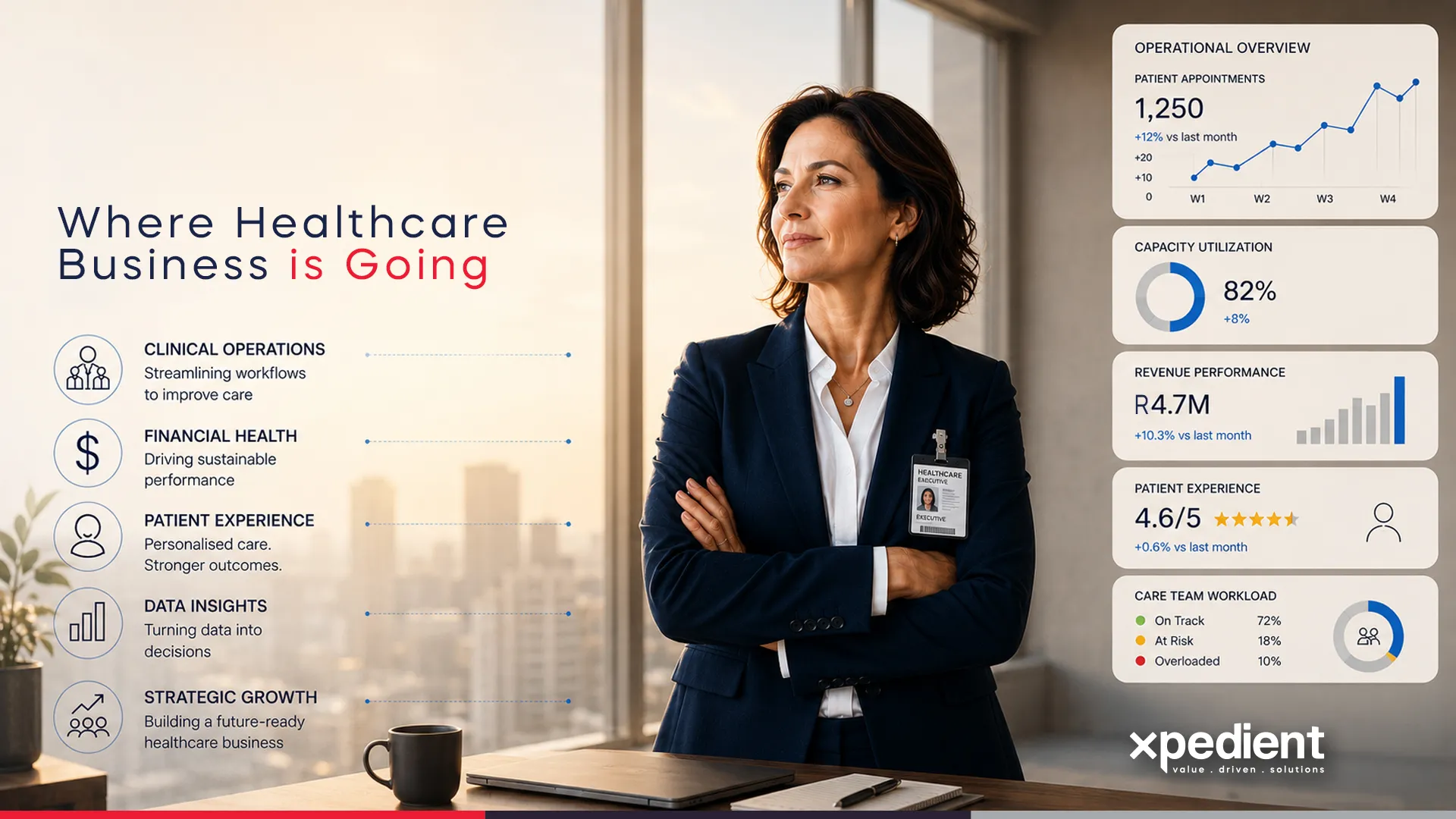
Healthcare is no longer just medicine. It is becoming a sophisticated business ecosystem.
Healthcare business is moving away from being defined by “healthcare” alone.
The next era belongs to businesses that understand they are operating at the intersection of:
- healthcare
- technology
- finance
- behavioural psychology
- data
- consumer expectation
The practices and healthcare groups that still think like traditional medical operators are going to feel increasing pressure. The ones that think like intelligent healthcare businesses will expand.
1. The specialist is becoming a business operator – whether they like it or not
For years, many specialists could rely on reputation, referrals, and clinical excellence alone.
That’s changing.
Margins are tightening. Medical aids are becoming more aggressive. Patients are behaving more like consumers. Operational inefficiency is becoming financially dangerous.
The future specialist practice will need:
- operational intelligence
- financial visibility
- strategic positioning
- digital systems
- patient experience management
Not because medicine is becoming commercialised in a shallow way – but because sustainability now requires business maturity.
Most specialists were never trained to run businesses. So the companies that can bridge that gap intelligently become incredibly valuable.
That is where healthcare support companies evolve from “service providers” into strategic infrastructure partners.
2. Data becomes the real competitive advantage
Healthcare businesses are drowning in information but starving for interpretation.
The winners will be the groups who can answer questions like:
- Which procedures are underperforming financially?
- Where is revenue leakage happening?
- Which schemes are slowing practice growth?
- What operational behaviours reduce collection cycles?
- Which doctors are scaling sustainably vs dangerously?
- Where are staffing inefficiencies emerging?
- Which patient behaviours predict bad debt?
Healthcare is becoming measurable in a way it never was before.
The businesses sitting closest to operational and financial data are quietly becoming some of the most strategically powerful players in healthcare.
3. Patients will expect healthcare to function like modern digital services
Not in terms of clinical care. In terms of experience.
People tolerate friction less than they used to.
They compare every interaction subconsciously to:
- banking apps
- Uber
- Amazon
- online payments
- instant communication
Healthcare has historically been protected from this expectation because it was seen as “different.”
That protection is disappearing.
The future patient expects:
- visibility
- convenience
- transparency
- responsiveness
- digital access
- payment flexibility
- communication that feels human
Not flashy. Just intelligently designed.
The practices that create calm, seamless experiences will build trust faster than practices relying purely on reputation.
4. Independent specialists will increasingly consolidate into ecosystems
Not necessarily formal hospital groups only.
But:
- networks
- partnership structures
- shared infrastructure
- shared admin
- shared data
- shared procurement
- shared technology
Running independently is becoming operationally expensive.
Healthcare is slowly moving from fragmented operators toward connected ecosystems.
5. Operational chaos is becoming expensive
Healthcare businesses built on operational chaos will increasingly struggle to compete.
The future advantage in healthcare may not belong to the businesses working the hardest.
It may belong to the ones operating the most intelligently.
Workflow.
Visibility.
Communication.
Decision-making.
Operational coordination.
Financial insight.
Healthcare is entering an era where inefficiency becomes far more visible — and far more expensive.
The businesses that scale sustainably will be the ones able to orchestrate systems, people, and operations intelligently.
6. Trust becomes more valuable, not less
As healthcare becomes more digital, human trust becomes even more important.
People want:
- expertise
- certainty
- guidance
- emotional intelligence
- credibility
Healthcare businesses that feel cold, transactional, or corporate will lose emotional loyalty.
The future belongs to businesses that combine:
- intelligent systems with
- deeply human communication
That combination is rare.
What is especially important in your space is this:
The healthcare businesses that win won’t just “do billing” or “offer software.”
They will become strategic growth infrastructure for practices.
The positioning changes from:
“we help run your admin”
to:
“we help build sustainable healthcare businesses.”
That is a fundamentally different category.
And very few companies in healthcare are positioning themselves there properly yet.